Medical billing, credentialing, marketing and EHR support across all 50 states

FREE FRONT-END REVENUE AUDIT Eligibility + Prior Authorization Protection

Insurance Eligibility Verification & Prior Authorization — Stop Denials Before the Patient Leaves the Building

Most billing practices focus on what happens after a claim is denied. The smarter approach is preventing the denial from happening at all. Eligibility verification and prior authorization are the two front-end services that do exactly that — and when either one is inconsistent, rushed, or skipped entirely, the practice pays for it 60 to 90 days later in the form of denied claims, delayed cash flow, and rework costs that could have been avoided with a five-minute check before the appointment.

A claim that fails because of a coverage lapse, an inactive subscriber ID, or a missing prior authorization does not generate an alert on the day of service. It generates an EOB 30–60 days later with a denial code, a rework task that costs $25–$118 to process, and — if nobody catches it before the payer appeal window closes — a permanent write-off on a service your provider delivered and your patient received.

Eligibility issues alone account for 24% of all claim denials nationally. Prior authorization problems account for another 12%. That is more than one in three denied claims that could have been prevented before the patient walked out the door.

PerfectMBS manages both services as a connected front-end protection system. We verify every patient's insurance coverage before every visit. We track and manage prior authorization requirements for every payer and every service type. And we handle retro-auth pursuit, auth denial appeals, and payer follow-up when the process fails.

Free Front-End Revenue Audit

No charge. No obligation. We audit your eligibility verification and prior authorization process, identify where front-end denials are originating, and deliver a written report with specific findings and dollar estimates in 5–7 business days.

Call Us Now: +1 (800) 000-0000
Front-End Revenue Protection

Verify. Authorize. Prevent Denials.

Live Audit View
Denial Prevention Opportunity 36%

of denials can originate from eligibility and prior authorization issues before the claim is ever submitted.

Before Visit Workflow Clean Claim Path
01 Verify

Coverage active

02 Check Auth

Payer rules reviewed

03 Submit

Clean claim ready

04 Collect

Fewer front-end denials

Front-End Denial Sources Eligibility + Auth
Eligibility Errors 24%
Prior Auth Issues 12%
Auth Denials Overturned 35%
Weekly Auth Load 41

requests per physician per week

Admin Time 14.9h

staff time per physician per week

Weekly Cost $2,161

average prior auth admin cost

Coverage Active
Subscriber ID Matched
Prior Auth Requirement Checked
Claim Ready Before Visit
24% Of All Claim Denials From Eligibility Errors Alone
41 Prior Auth Requests Per Physician Per Week
14.9 Hours Staff Time Spent Per Physician Per Week on Prior Auths
$2,161 Average Weekly Cost Per Physician in Prior Auth Admin
94% Of Physicians Say Prior Auth Delays Patient Care
35% Of Prior Auth Denials Overturned on Appeal
Two Services. One Problem. One Solution.

Why Eligibility and Prior Authorization Are Front-End Problems — and Why They Have to Be Solved Together

Eligibility verification and prior authorization are different tasks managed at different points in the scheduling and intake workflow. But they fail for the same reason and produce the same result — a claim denied weeks after service for something that could have been resolved with an extra step at the front desk.

When practices manage them inconsistently, the back-end billing team pays the price: more denials to work, more rework to fund, and more revenue sitting in an A/R aging report that should have been paid on first submission.

Eligibility verification answers the question: is this patient covered, by which plan, for which services, and what are their cost-sharing obligations today? Prior authorization answers the question: does this payer require advance approval for the service the provider is planning to deliver — and if so, has it been obtained?

Both answers are required before the service is rendered. Both are preventable revenue risks when the answers are wrong or missing.

PerfectMBS manages both as a single front-end workflow.

The eligibility check informs the authorization requirement. The authorization status informs what can be scheduled and billed. When the two work together in a single managed system, front-end denials fall sharply — and they stay down.

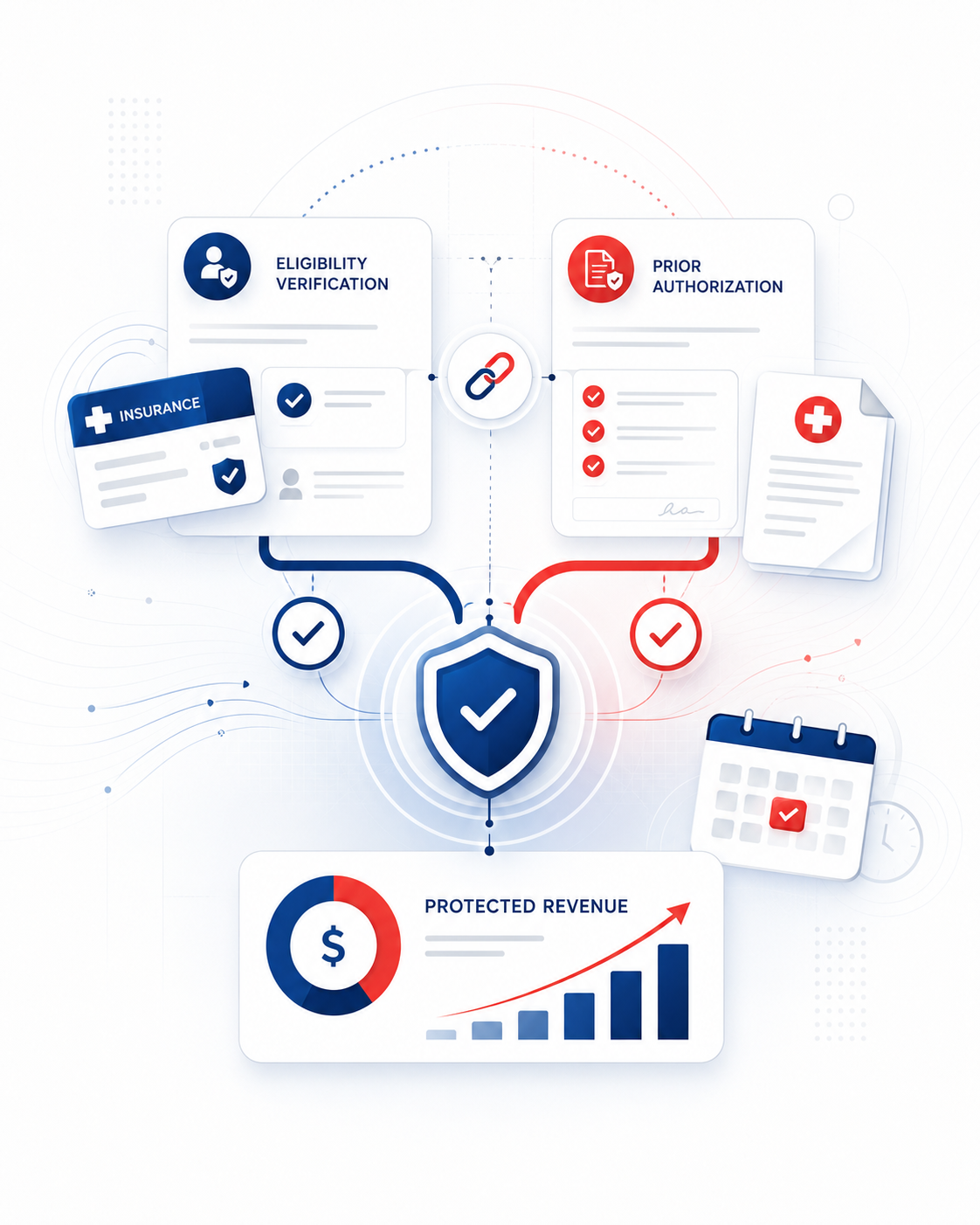
Eligibility verification and prior authorization workflow connected into protected revenue
01 Verify Coverage
02 Check Authorization
03 Protect Revenue
The Real Cost of Eligibility Errors

What Happens to Your Revenue When Coverage Is Not Verified Before the Visit

An eligibility error is not just a billing inconvenience. It is a claim denial with a rework timeline attached to it — and depending on how long it takes to identify and resolve, it becomes a write-off.

The most common eligibility errors are not dramatic failures. They are routine gaps: a patient whose plan changed on the first of the month, a subscriber ID that was re-issued after an insurance card update, a dependent who aged off their parent's plan, a patient seen under the wrong payer entirely because nobody confirmed coverage at check-in.

Each of these produces the same back-end result. The claim submits, the payer processes it against the wrong subscriber or an inactive policy, and the EOB comes back denied. The billing team identifies the denial, investigates the eligibility issue, corrects the claim data, and resubmits — at a cost of $25–$118 in rework time per claim.

If the resubmission is outside the payer's timely filing window, the revenue is gone entirely. If the patient has since changed insurance or lost coverage, the balance may become uncollectable patient bad debt.

The fix is not expensive.

It is a real-time eligibility check before every appointment. PerfectMBS runs it for every patient, every visit, before the provider ever enters the room.

Eligibility Error Cost Model

One Small Front-End Gap Becomes a Revenue Leak

Weekly Impact
Example Practice Volume
150 patient encounters per week
5%

Eligibility Error Rate

7–8

Claim Problems Weekly

Not Verified
Claim Denied
Rework Cost
Revenue at Risk
Average Rework Cost $60

per eligibility-related problem

Average Claim Value $350

per patient encounter

Preventable Weekly Loss Exposure $3,045
Rework Cost $420
Claim Value at Risk $2,625
Annual Rework Cost $22,000
Annual At-Risk Revenue $136,000
Real-time eligibility before every visit
Active coverage confirmed before service
Subscriber and payer details checked early
Fewer avoidable eligibility denials
Eligibility Error Cost Map

The 6 Most Common Eligibility Errors — and What Each One Costs

Most eligibility-related denials come from small front-end gaps that look routine at check-in but become expensive billing problems weeks later. Each error below creates a different claim impact, recovery path, and revenue risk.

01
Inactive or Lapsed Coverage

Policy terminated or no active coverage for the date of service.

How It Happens

Patient's policy terminated; practice has old card on file.

Claim Impact

Full claim denial — payer has no active coverage for date of service.

Recovery Path

Corrected claim with updated coverage; patient financial responsibility if no new coverage exists.

02
Wrong Insurance on File

Prior payer is still attached even after the patient changed plans.

How It Happens

Patient changed employers or plans; front desk has prior plan.

Claim Impact

Full claim denial under wrong payer; delay of 30–60 days while correct payer is identified.

Recovery Path

Corrected claim to correct payer; original claim write-off if timely filing has passed under correct payer.

03
Dependent Eligibility Lapse

Dependent coverage ended but the record was not updated before service.

How It Happens

Patient aged off parent plan; pediatric patient over coverage age limit.

Claim Impact

Full claim denial — dependent no longer covered under subscriber plan.

Recovery Path

Patient's own plan verification if coverage transitioned; patient financial responsibility otherwise.

04
Network Status Error

Patient believes the provider is in-network, but payer rules say otherwise.

How It Happens

Provider seen as in-network by patient; actually out-of-network for that payer.

Claim Impact

Claim paid at out-of-network rate or denied; patient balance dispute.

Recovery Path

Limited recovery; patient surprise billing notice requirements apply in many states.

05
Benefits Not Verified for Service Type

Coverage is active, but the specific service benefit was never checked.

How It Happens

Coverage active but specific benefit not confirmed, such as mental health, PT visit limits, or specialty coverage.

Claim Impact

Claim denied for benefit not covered or limit exhausted.

Recovery Path

Appeal with benefits documentation; patient financial responsibility if benefit is genuinely exhausted.

06
Coordination of Benefits Incorrect

Primary and secondary payer order is wrong or outdated.

How It Happens

Primary and secondary payer order wrong; COB information outdated with payer.

Claim Impact

Secondary claim denied; primary payment applied incorrectly.

Recovery Path

COB investigation; primary resubmission; secondary coordination after primary pays.

Every eligibility error has one thing in common: it could have been caught before the visit.

PerfectMBS verifies coverage, payer details, benefits, network status, and coordination issues before the service is rendered — so your billing team is not forced to recover revenue after the damage is already done.

PRIOR AUTHORIZATION MANAGEMENT Administrative burden + denial prevention

The Prior Authorization Crisis in Medical Billing

What the Numbers Say About Prior Auth — and Why the Burden Keeps Getting Worse

The AMA's most recent Physician Practice Benchmark Survey documents the scope of the prior authorization problem with specificity that is difficult to dismiss. The average physician practice completes 41 prior authorization requests per physician per week. Staff managing those requests spend 14.9 hours per physician per week — nearly two full business days — on prior auth administrative tasks. The total administrative cost of prior authorization management averages $2,161 per physician per week across the industry.

That cost does not include denied authorizations. It does not include retro-auth pursuit on services where authorization was missed. It does not include the clinical cost of care delays — 94% of physicians report that prior authorization delays patient access to necessary care, and 33% have had a patient experience a serious adverse event as a direct result of a prior auth delay. The administrative burden is significant. The clinical consequences are worse.

The problem is also growing. Prior authorization denial rates have increased 56% over the past five years as payers have expanded the services requiring advance approval and deployed automated review systems that apply AI-driven clinical criteria to authorization decisions. More services require auth than ever before. More of those auth requests are being denied on first submission.

And 35% of prior auth denials that are formally appealed are overturned — which means more than one in three initial denials was incorrect. Practices that do not appeal are accepting wrong denials as final answers, permanently.

PerfectMBS handles the full prior authorization cycle.

We track requirements by payer and procedure, submit and follow up on every auth request, appeal wrongful denials, and pursue retroactive authorization where clinical documentation supports it. Your clinical team orders the service. We handle everything else.

Prior Auth Burden Snapshot

Every Physician. Every Week. Real Administrative Cost.

Auth Load
Average Requests
41 prior auth requests per physician per week
Staff Time 14.9h

per physician per week

Admin Cost $2,161

average weekly cost

Auth Pressure Indicators Rising
Care Delays 94%
Serious Adverse Events 33%
Denial Rate Growth 56%
Appeals Overturned 35%
Track
Submit
Follow Up
Appeal
Wrong denials should not become permanent write-offs.

When appeals are not worked, overturned denials become lost revenue.

2025–2026 AUTH RISK MAP Common services requiring prior authorization

Services Most Commonly Requiring Prior Authorization in 2025–2026

PerfectMBS manages prior authorization requirements across high-risk service categories, payer rules, clinical documentation needs, follow-up timelines, and appeal workflows.

01
Diagnostic Imaging

MRI, CT, PET, and advanced imaging

Common Payers Requiring Auth

Most commercial payers; Medicare Advantage plans.

Auth Timeline Risk

Auth often required 48–72 hours before service; denial if service rendered without auth.

PerfectMBS Management

Auth requirement check per payer and CPT; submission and follow-up before scheduling confirmed.

02
Outpatient Surgery and Procedures

Scheduled procedures with payer approval requirements

Common Payers Requiring Auth

All major commercial payers; most Medicare Advantage.

Auth Timeline Risk

Service cannot proceed without auth; retroactive auth rarely granted.

PerfectMBS Management

Surgical auth submitted at scheduling; follow-up to confirmation before date of service.

03
Specialty Referrals

Cardiology, neurology, orthopedics, oncology

Common Payers Requiring Auth

HMO and EPO plans; some PPOs.

Auth Timeline Risk

Referral denied if not pre-approved; specialist visit billed without valid referral equals denial.

PerfectMBS Management

Referral auth tracking per payer and specialty; coordination with referring provider.

04
Behavioral Health

Inpatient and residential treatment

Common Payers Requiring Auth

All major commercial payers; Medicaid.

Auth Timeline Risk

Level of care auth required before admission; concurrent auth required for continued stay.

PerfectMBS Management

Admission auth submitted with clinical documentation; concurrent auth managed by stay duration.

05
Durable Medical Equipment

DME orders, equipment, and supplier coordination

Common Payers Requiring Auth

Medicare; most commercial payers.

Auth Timeline Risk

Auth required before dispensing; denial if equipment provided without prior approval.

PerfectMBS Management

DME auth submitted with physician order and clinical notes; supplier coordination.

06
Physical, Occupational, and Speech Therapy

Visit limits, evaluations, and extension requests

Common Payers Requiring Auth

Most commercial payers; Medicare Advantage.

Auth Timeline Risk

Visit limits enforced; auth required after initial evaluation in many plans.

PerfectMBS Management

PT/OT/ST auth tracking by visit count and payer; extension auth submitted before limit reached.

07
High-Cost Medications and Biologics

Drug approvals, step therapy, and clinical documentation

Common Payers Requiring Auth

All major commercial; Medicare Part D plans.

Auth Timeline Risk

Step therapy requirements; prior treatment failure documentation required.

PerfectMBS Management

Drug auth submitted with step therapy documentation; appeal if step therapy waiver is warranted.

08
Home Health and Skilled Nursing

SNF, home health, and extended-care authorization

Common Payers Requiring Auth

Medicare; most commercial payers.

Auth Timeline Risk

Auth required before first visit; concurrent auth for extended stays.

PerfectMBS Management

SNF and home health auth submitted with physician order and qualifying event documentation.

ELIGIBILITY VERIFICATION COVERAGE Every check. Every visit. Every payer.

What PerfectMBS Eligibility Verification Covers

Every Check, Every Visit, Every Payer — Before the Claim Is Ever Written

Front-End Claim Protection System

PerfectMBS does not treat eligibility as a quick yes/no check. We verify the full revenue risk before the visit happens.

Coverage status, benefits, network status, coordination of benefits, and eligibility-related denial patterns are managed together so your practice can prevent avoidable denials before the claim is ever created.

Live Eligibility Check Before Every Visit

Coverage, benefits, payer sequence, and risk flags verified before service.

Coverage
Benefits
Network
COB
01

Real-Time Insurance Eligibility Verification

Coverage status confirmed before the patient reaches the visit.

PerfectMBS runs a real-time eligibility check for every scheduled patient before every appointment — not the night before in a batch, not at check-in when the patient is already in the waiting room, but as part of the scheduling confirmation workflow.

We verify coverage status, effective dates, group and subscriber ID, and plan type against the payer's live enrollment database. If coverage is inactive or incorrect, we flag it before the visit so the front desk can resolve it before the service is delivered and the billing clock starts.

This is not a once-per-patient verification. Coverage changes. Patients change employers, change plans, and lose coverage without informing their provider. Every visit is a new eligibility event that requires a current check against the payer's live records.

What You Receive

A verified eligibility status for every scheduled patient, updated before every appointment, with flag alerts sent to your scheduling team for any coverage discrepancy that requires resolution before the visit.

02

Benefits Verification — Coverage Depth, Not Just Active Status

Deductibles, copays, coinsurance, exclusions, and visit limits checked before service.

Confirming that a patient's insurance is active is necessary but not sufficient. PerfectMBS also verifies the benefits that apply to the specific services the patient is scheduled to receive — deductible amounts and how much has been met, copay and coinsurance obligations, out-of-pocket maximum and current accumulation, visit limits for therapy or behavioral health services, and any service-specific exclusions that would affect billing.

Benefits verification prevents two specific problems: claims denied because a benefit is exhausted or a service is excluded, and patient billing disputes when a patient receives a balance due they were not expecting.

When a patient knows their cost-sharing responsibility before the visit — because the front desk told them, based on a PerfectMBS benefits check — the collection rate on patient balances at point of service improves significantly.

What You Receive

A complete benefits summary per patient per visit — deductible status, copay and coinsurance amounts, out-of-pocket accumulation, visit limit tracking, and any service-specific coverage notes relevant to the scheduled encounter — formatted for your front desk to communicate to the patient at check-in.

03

Network Status Verification

Provider-patient-payer network status confirmed before care is delivered.

Every physician and facility in your practice needs to be confirmed as in-network with each patient's specific insurance plan — not just the payer, but the specific product.

A patient on a Blue Cross PPO and a patient on a Blue Cross EPO may have completely different network rosters. A provider credentialed with the commercial plan may not be listed in the Medicare Advantage network of the same payer. PerfectMBS verifies your providers' in-network status against each patient's specific plan at every visit.

Out-of-network services generate one of the most contentious patient billing situations in medical practice — particularly under federal surprise billing rules that limit balance billing for many emergency and non-emergency out-of-network services. Verifying network status before service eliminates the ambiguity and protects both the practice's revenue and the patient's trust.

What You Receive

A network status confirmation for each provider-patient-payer combination, flagging any out-of-network situations that require patient notification, prior disclosure under No Surprises Act requirements, or scheduling rerouting before service.

04

Coordination of Benefits Identification

Primary and secondary payer sequence confirmed before the claim is written.

When a patient has more than one active insurance policy — primary employer coverage plus a spouse's plan, Medicare plus a supplemental Medigap policy, Medicaid as a payer of last resort — the order in which payers are billed determines which claim pays and which is billed as secondary.

Getting this wrong produces a cascade: the secondary payer denies because the primary was never billed first, or the primary denies because the incorrect plan was listed as primary.

PerfectMBS identifies COB situations during eligibility verification, confirms the correct payer sequence, and sets up the claim to be billed in the right order from the start.

What You Receive

A COB flag on every patient with multiple active insurances — with the correct primary and secondary payer sequence confirmed and documented before the claim is written, preventing the most common secondary billing errors.

05

Eligibility Denial Tracking and Root Cause Reporting

Every eligibility denial becomes a process improvement signal — not just another claim to rework.

When an eligibility-related denial reaches the billing team, PerfectMBS traces it back to the specific verification failure — which check was missed, which payer returned incorrect data, which front desk step was skipped — and feeds that root cause back into the verification workflow to prevent recurrence.

A denial that comes back as CO-270, information requested not provided, or CO-27, expenses incurred after coverage terminated, is not just a claim to rework. It is a front-end process failure that will repeat until the specific gap is identified and closed.

What You Receive

A monthly eligibility denial analysis showing your eligibility-related denial volume by code, by payer, and by root cause — with specific front-end process fixes recommended for each recurring category.

Eligibility verification is not one task. It is a front-end revenue protection system.

PerfectMBS checks coverage, benefits, network status, COB, and eligibility denial patterns before they become avoidable write-offs inside your A/R.

Get My Free Front-End Revenue Audit
PRIOR AUTHORIZATION MANAGEMENT From requirement check to approval confirmation

What PerfectMBS Prior Authorization Management Covers

Complete Auth Cycle Management — From Requirement Check to Approval Confirmation

Complete Auth Cycle Control

PerfectMBS manages every authorization touchpoint before it becomes a denied claim, a delayed procedure, or a missed approval window.

We identify payer-specific auth requirements, submit requests, track open approvals, escalate delays, manage expedited reviews, appeal denials, pursue retro-auth where available, and monitor expiration or concurrent review deadlines.

Auth Lifecycle Checked. Submitted. Tracked. Appealed.

Every open authorization is managed against payer rules, service dates, documentation needs, and approval deadlines.

Identify
Submit
Track
Approve
01

Authorization Requirement Identification

Payer-specific auth rules checked before the service is scheduled or delivered.

Every payer maintains its own prior authorization requirements — which services require advance approval, which CPT codes are exempt, which plans within the same payer require auth and which do not, and which clinical criteria must be met for auth to be granted.

These requirements change. Payers update their coverage policies quarterly. Services that did not require auth last year may require it today. PerfectMBS maintains a current, payer-specific authorization requirement database for every active payer in your mix — so that your scheduling team never proceeds with a service that requires auth without knowing it first.

What You Receive

A current authorization requirement matrix for your active payer mix — updated when payers issue policy changes — showing which services require auth for which payers, with CPT code specificity, so your scheduling team has a single reference point for every booking decision.

02

Authorization Submission and Management

Submission, reference tracking, payer follow-up, and determination monitoring.

Once a prior authorization requirement is identified, PerfectMBS handles the complete submission process — clinical documentation assembly, auth request submission through the payer portal or by phone where portals are not available, reference number tracking, and follow-up until a determination is received.

Auth requests are submitted at the earliest possible point after scheduling — not the day before the service — to ensure that the payer's review timeline does not create a scheduling conflict or a care delay.

Every open auth request is tracked against the payer's stated turnaround time. If a determination is not received within the expected window, PerfectMBS initiates follow-up before the service date — not after.

What You Receive

A fully managed prior auth submission pipeline — every open auth request tracked from submission to determination, with automated follow-up before the service date and escalation when payer response exceeds the committed timeline.

03

Urgent and Expedited Authorization Management

Fast-path auth handling for urgent, time-sensitive clinical services.

Some prior authorizations cannot wait five to seven business days for standard review. Emergency admissions, time-sensitive surgeries, and urgent oncology treatment requests require expedited authorization pathways — and most payers are required by state or federal regulation to issue expedited auth decisions within 24–72 hours when the clinical urgency is documented.

PerfectMBS identifies when expedited review is clinically appropriate, submits the request through the correct expedited pathway, and follows up within hours — not days.

Missing the expedited auth window on a time-sensitive service forces a choice between delaying care and proceeding without auth and accepting a likely denial. Neither outcome is acceptable. PerfectMBS manages the timeline to prevent that choice from arising.

What You Receive

Expedited auth requests submitted through the correct payer pathway with same-day follow-up — with documentation of medical urgency assembled and submitted to meet the payer's expedited review criteria.

04

Prior Authorization Denial Appeals

Clinical appeals, peer-to-peer coordination, and external review escalation.

A prior authorization denial is not a final answer. The AMA reports that 35% of prior auth denials that are formally appealed are overturned — meaning more than one in three initial denials was wrong.

PerfectMBS manages the complete auth appeal process: clinical appeal letter preparation with supporting documentation, peer-to-peer review scheduling between the treating physician and the payer's medical director, and external independent review escalation where state law permits or the clinical evidence is strong.

Auth appeals require a different skill set from claim appeals — they are clinical arguments, not billing arguments — and PerfectMBS prepares them with the clinical depth that payer medical directors actually respond to.

What You Receive

A fully managed auth denial appeal pipeline — clinical appeal letters prepared with policy citations and clinical evidence, peer-to-peer reviews coordinated and scheduled, and external reviews filed where applicable — tracked to final determination.

05

Retroactive Authorization Pursuit

Retro-auth review for authorization-related denials where recovery may still be possible.

When a service is provided without authorization — whether because the auth was missed, the auth requirement was unknown, or the payer's system failed to properly communicate the requirement — retroactive authorization may still be available through the payer's retro-auth process.

Retro-auth is not guaranteed, and many payers restrict it to genuine clinical emergencies. But where it is available and the clinical documentation supports it, pursuing retro-auth is the difference between recovering the revenue and writing it off entirely.

PerfectMBS reviews every authorization-related denial for retro-auth eligibility and pursues it immediately when the option exists.

What You Receive

A retro-auth review on every authorization-related claim denial — with retro-auth submission where the payer permits and the clinical documentation supports, and formal denial appeal preparation for denials where retro-auth is not available but the denial is clinically contestable.

06

Authorization Expiration Tracking

Renewal monitoring before active approvals expire and turn into denial risk.

Prior authorizations are not permanent. Most auth approvals have an expiration date — typically 30 to 90 days from the approval date — after which the authorization is no longer valid for billing purposes.

Services rendered after an auth expires are billed without a valid auth and are denied exactly as if no auth had been obtained at all.

PerfectMBS tracks the expiration date of every active authorization and initiates renewal requests before the original auth expires — so there is no gap between auth coverage and service delivery.

What You Receive

An active authorization expiration calendar for every open auth in your system — with renewal requests submitted 10–14 days before expiration to ensure continuous coverage with no gap-related claim denials.

07

Concurrent Authorization Management — Inpatient and Continued Stay

Continued-stay review calendars managed before each authorization period expires.

For inpatient admissions, residential behavioral health stays, and skilled nursing facility placements, the initial admission authorization covers only the first approved period of care. Continued stay beyond the initially authorized period requires concurrent authorization — a new clinical review submitted during the active stay to extend approval.

Missing a concurrent auth deadline produces a denial for every day of care beyond the originally authorized period. PerfectMBS manages the concurrent auth calendar for every active inpatient case, submits continued stay requests on time with updated clinical documentation, and appeals adverse decisions immediately.

What You Receive

A concurrent auth management calendar for every active inpatient or residential case — with continued stay submissions prepared and submitted before each authorization period expires and appeals managed in real time when concurrent auth is denied.

Prior authorization is not just paperwork. It is approval-risk management.

PerfectMBS keeps every auth requirement, submission, follow-up, appeal, retro-auth opportunity, expiration date, and concurrent review deadline moving before it becomes a denial.

Get My Free Front-End Revenue Audit
FRONT-END REVENUE WARNING SIGNS Eligibility + auth failures you can measure

Signs Your Practice Has a Front-End Revenue Problem Right Now

These are the specific situations where eligibility and prior authorization failures are costing practices measurable, recoverable revenue.

Revenue Risk Check

If even two or three of these signs are happening inside your practice, your front-end process is already creating preventable denials.

Eligibility and authorization problems usually do not look urgent on the day of service. They show up weeks later as denied claims, rework tasks, avoidable patient billing issues, and revenue sitting inside A/R that should have been paid on first submission.

Front-End Risk Indicators 10

high-risk signals that eligibility and auth failures are leaking revenue.

CO Codes 270 / 27 / 22
Target Auth Approval 90%+
Risk Zone <85%
01

Eligibility Denials Keep Appearing in A/R

You have eligibility-related denials appearing in your A/R every month — CO-270, CO-27, or CO-22 denial codes are reliable indicators that coverage is not being verified correctly before service.

02

Missing Prior Auths Are Found After Service

Your billing team discovers missing prior authorizations after the service has been delivered — retro-auth is sometimes available, but the revenue is at risk every time it has to be pursued.

03

Insurance Is Verified From the Patient Card Only

Your front desk verifies insurance on the phone using information from the patient's card — not real-time verification against the payer's current enrollment database.

04

No Centralized Auth Requirement System

You have multiple payers in your mix with different prior auth requirements — and no centralized system tracking which services require auth for which plan on which CPT code.

05

Auth Denials Spike After Payer Policy Updates

You are seeing a spike in auth-related denials following a payer's quarterly coverage policy update — which means nobody caught the policy change before it began producing denials.

06

Care Delays Are Causing Patient Complaints

You have had care delays because a prior authorization was not obtained before scheduling — and the patient or referring provider escalated the delay as a complaint.

07

Prior Auth Approval Rate Is Below 85%

Your prior authorization approval rate is below 85% on first submission — industry benchmark is 90%+, and anything below suggests clinical documentation or submission process gaps.

08

Concurrent Auths Are Not Clearly Tracked

You have active inpatient or residential cases and cannot confirm whether concurrent authorizations have been submitted for every case in the current stay period.

09

New Payers Were Added Without an Auth Audit

You added new payers or a new insurance product line in the past 12 months and have not audited whether your auth requirement tracking reflects the new payer's specific policies.

10

Authorization Expiration Dates Are Not Tracked at Claim Level

You do not currently track authorization expiration dates at the claim level — which means some authorized services are being billed after the auth has expired without anyone catching it.

These problems are measurable — and most of them are recoverable.

PerfectMBS audits your eligibility and prior authorization workflow, identifies where front-end denials are originating, and shows exactly which process gaps are putting revenue at risk before the claim is ever written.

Get My Free Front-End Revenue Audit
WHY PERFECTMBS Prevention before recovery

Why PerfectMBS for Eligibility Verification and Prior Authorization

Prevention requires a different discipline than recovery. PerfectMBS protects revenue before the claim is ever written — reducing denials, rework, delays, and avoidable write-offs.

Prevention Requires a Different Discipline Than Recovery

We Prevent. Most Billing Services Recover.

The majority of billing services focus on what happens after a claim is submitted — working denials, chasing A/R, filing appeals. PerfectMBS manages the front end with equal discipline, because a dollar of prevention at the eligibility or auth stage is worth more than a dollar of recovery after the denial has been issued.

Prevention eliminates the rework cost, the collection delay, and the risk of missing the appeal window. Recovery always costs more and always recovers less.

PerfectMBS focuses on stopping preventable denials before they enter your A/R.

PerfectMBS protects the claim before it becomes a denial.

We combine real-time eligibility verification, payer-specific prior authorization tracking, clinical appeal preparation, and full revenue cycle integration so your practice prevents the front-end failures that create avoidable A/R.

Get My Free Front-End Revenue Audit
SPECIALTIES WE SERVE Eligibility + prior authorization across every major specialty

PerfectMBS Manages Eligibility Verification and Prior Authorization Across Every Major Clinical Specialty

Prior authorization requirements and eligibility complexity vary significantly by specialty. Each specialty below can connect to a dedicated service page for specialty-specific billing, eligibility, and authorization support.

Specialty-Specific Front-End Protection

Different specialties face different payer rules, CPT-level auth requirements, benefit limits, and documentation risks.

PerfectMBS tracks eligibility and authorization requirements by specialty, payer, plan, service type, and procedure so your front-end workflow stays accurate before care is delivered.

01 Primary Care

Eligibility checks, benefits verification, and payer-specific front-end protection.

02 Internal Medicine

Coverage, referrals, and authorization support for high-volume adult care.

03 Orthopedics

Auth management for imaging, procedures, injections, surgery, and therapy referrals.

04 Cardiology

Procedure, diagnostic, imaging, and payer-specific authorization tracking.

05 Behavioral Health

Benefits verification, visit limits, level-of-care authorization, and concurrent review.

06 Oncology

Urgent auth handling for treatments, imaging, biologics, and high-cost medications.

07 Neurology

Specialty referrals, diagnostics, imaging authorizations, and payer policy checks.

08 Gastroenterology

Procedure authorization, colonoscopy coverage checks, and payer-specific rules.

09 Dermatology

Coverage verification for procedures, biopsies, specialty visits, and treatment plans.

10 Urgent Care

Fast eligibility checks, payer confirmation, and front-end denial prevention.

11 Pediatrics

Dependent eligibility, benefits verification, coverage changes, and payer matching.

12 OB/GYN

Coverage checks for maternity care, procedures, imaging, and specialty visits.

13 Physical Therapy & Rehabilitation

Visit limit tracking, therapy benefits, authorization extensions, and payer rules.

14 Radiology

Advanced imaging authorization checks for MRI, CT, PET, and diagnostic studies.

15 Ophthalmology

Procedure, diagnostic, and payer-specific authorization support for eye care.

16 Podiatry

Eligibility, benefits, referral, and coverage verification for foot and ankle care.

17 Pain Management

Auth tracking for injections, procedures, imaging, and treatment plans.

18 Rheumatology

High-cost medication, biologic, infusion, and specialty care authorization support.

19 Home Health

Initial auth, concurrent auth, eligibility, and payer-specific care approval tracking.

20 Multispecialty Practices

Centralized eligibility and prior auth management across multiple service lines.

Not seeing your specialty?

Contact us — PerfectMBS serves all clinical specialties and practice types across all 50 states.

Contact PerfectMBS
HOW IT WORKS Four steps to a protected front end

How It Works — Four Steps to a Protected Front End

The process is designed to slot into your existing workflow without disruption. PerfectMBS audits your current front-end risks, activates eligibility and authorization management, and then keeps the process running with monthly performance reporting.

Implementation Without Disruption

Your team keeps using its existing workflow. PerfectMBS adds the front-end protection layer that prevents avoidable denials before claims are written.

From the first audit to ongoing monthly reporting, every step is built around reducing eligibility denials, missed authorizations, retro-auth exposure, and front-end revenue leakage.

Typical Activation 5–10

business days for most practices after intake and access setup.

Audit
Analyze
Activate
Manage
01

Free Front-End Revenue Audit

Your time: 5 minutes

Start

Fill out the form or call us. Tell us your specialty, monthly patient volume, primary payer mix, and your biggest current front-end challenge — eligibility errors, auth denials, retro-auth situations, or all three.

PerfectMBS confirms your request within one business day and schedules your intake call.

Outcome

Your audit request is opened, your front-end risk category is identified, and your intake call is scheduled.

02

Front-End Audit and Gap Analysis

Your time: 20 minutes

Review

A PerfectMBS eligibility and authorization specialist reviews your current verification workflow, authorization requirement tracking, and a sample of your front-end denial data.

We identify where coverage verification is breaking down, which services are generating the most auth-related denials, and how much front-end revenue risk your current process is carrying.

Outcome

You receive a written report with specific findings and dollar estimates — regardless of what you decide next.

03

Integration and Activation

Your time: Minimal

Launch

PerfectMBS integrates with your scheduling and practice management workflow to access appointment data, confirm eligibility check timing, and establish the prior authorization tracking process for your active payer mix.

Your scheduling staff receives a clear protocol for escalating eligibility flags and auth confirmation requirements. Your clinical team continues without disruption.

Outcome

Most practices are fully operational under PerfectMBS front-end management within 5–10 business days.

04

Ongoing Management and Monthly Reporting

Your time: 30 minutes per month

Improve

Eligibility is verified for every patient before every visit. Auth requests are submitted and tracked for every service that requires advance approval. Auth denials are appealed. Expirations are tracked and renewals are submitted before coverage gaps occur.

Each month, you receive a front-end performance report showing your eligibility denial rate, auth approval rate on first submission, auth denial appeal outcomes, and total front-end denial volume compared to your baseline.

Outcome

The trend line moves down over time — and stays down.

Start with a free front-end revenue audit.

PerfectMBS will show you where eligibility errors, missed authorizations, retro-auth exposure, and expired approvals are putting revenue at risk before claims are ever submitted.

Get My Free Front-End Revenue Audit
FREQUENTLY ASKED QUESTIONS AEO-ready answers for eligibility and prior authorization

Frequently Asked Questions

Clear answers about insurance eligibility verification, prior authorization, Medicare Advantage auth rules, appeals, concurrent authorization, and front-end denial prevention.

Insurance eligibility verification in medical billing is the process of confirming that a patient's insurance coverage is active, that the services they are scheduled to receive are covered under their specific plan, and that the provider billing for those services is in-network — before the service is rendered.

It includes verifying the patient's subscriber ID, group number, effective dates, benefit details including deductible, copay, coinsurance, out-of-pocket maximum, visit limits, and coordination of benefits when the patient has multiple active plans.

Effective eligibility verification prevents the single largest category of preventable claim denials — coverage errors that originate at the front desk and produce billing problems 30 to 60 days later.

Still have questions about eligibility, prior auth, or front-end denial risk?

PerfectMBS can audit your current process and show exactly where preventable denials are entering your revenue cycle.

Get My Free Front-End Revenue Audit
FREE FRONT-END REVENUE AUDIT Zero cost. Written report. Yours to keep.

Every Denied Claim That Starts With a Missed Eligibility Check or a Missing Auth Was Preventable. The Audit Shows You Where Yours Are Coming From.

Right now your practice is scheduling patients, verifying coverage with varying consistency, tracking prior authorization requirements across multiple payers with different rules, and trusting that the front-end workflow is catching everything that needs to be caught before the service is delivered.

When it does not — when a coverage status is wrong, when an auth requirement is missed, when a concurrent auth slips past the deadline — the consequence shows up in your A/R 30 to 90 days later as a denial code, a rework task, and a percentage of permanent revenue loss that nobody ever connects back to the front-end gap that caused it.

The PerfectMBS free front-end revenue audit shows you exactly where those gaps are: which eligibility checks are being skipped or done incorrectly, which payers are generating the most auth-related denials, which services are being delivered without confirmed authorizations, and what those failures are costing every month.

Zero cost. Written report. Five to seven business days. Yours to keep regardless of what you decide.

Audit Offer

FREE FRONT-END REVENUE AUDIT

No Cost
Front-End Denial Source
24%

of all claim denials originate at the front end — from eligibility errors and missed authorizations that could have been caught before the patient was ever seen.

No Charge
No Obligation
Written Report
5–7 Business Days

What happens when you request your free audit:

01

Fill out the form — 5 minutes, no preparation or data export needed before the call.

02

We confirm within one business day and schedule your 20-minute intake call.

03

We review your eligibility workflow, auth tracking, and front-end denial data.

04

We deliver a written audit report with specific gap findings and dollar estimates.

05

You keep the report — and decide what you want to do next, entirely on your terms.